
In 2015, I began to think about reworking a Roman myth based on the god of the sea, Neptune, and his pursuit of the goddess Salacia. The inspiration for this was a memory of a mosaic that I saw many years ago in Herculaneum, but I was also compelled, following a more recent trip to Thailand, to paint a beach scene and incorporate both the male and female figure.
The Herculaneum Mosaic
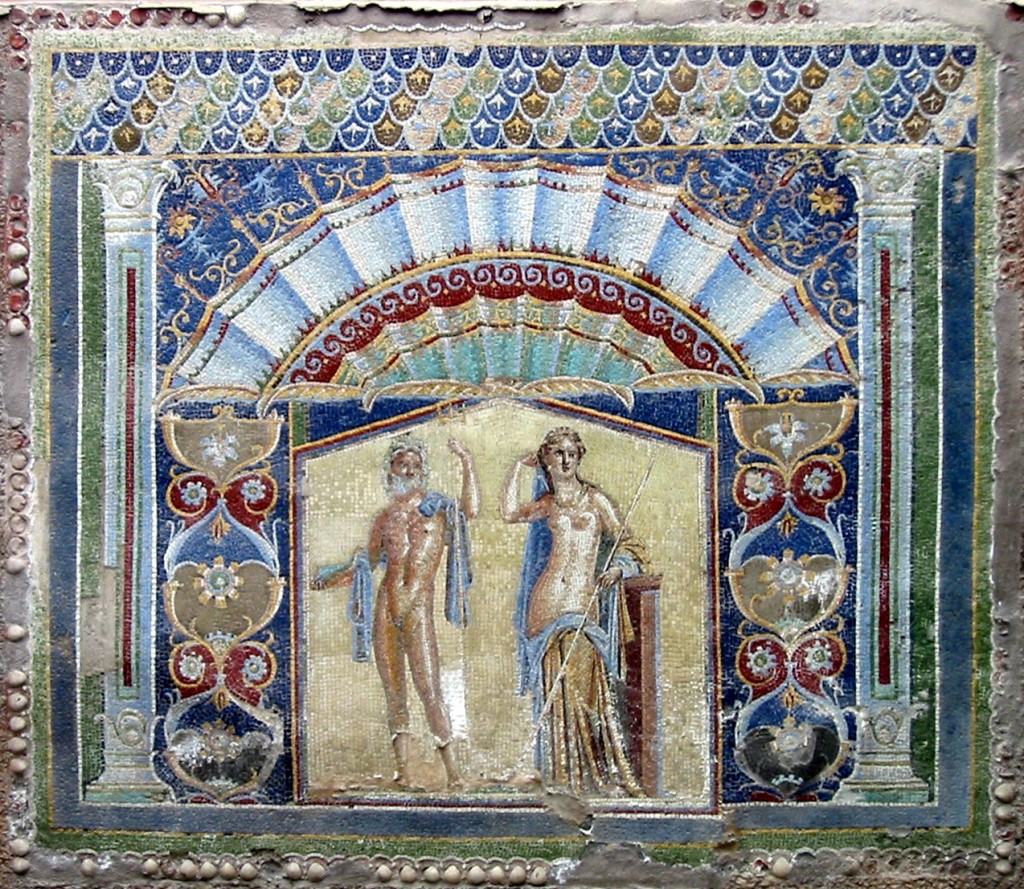
Neptune and Salacia, mosaic photographed in Herculaneum in 2002
In 2002, I visited Herculaneum, which was in a far better state of conservation than Pompeii. During that visit I took a photograph of a wall mosaic in House Number 22.
Later, I made a number of collages that were inspired by those wonderful mosaics which had survived the eruption of Vesuvius in 79 A.D.
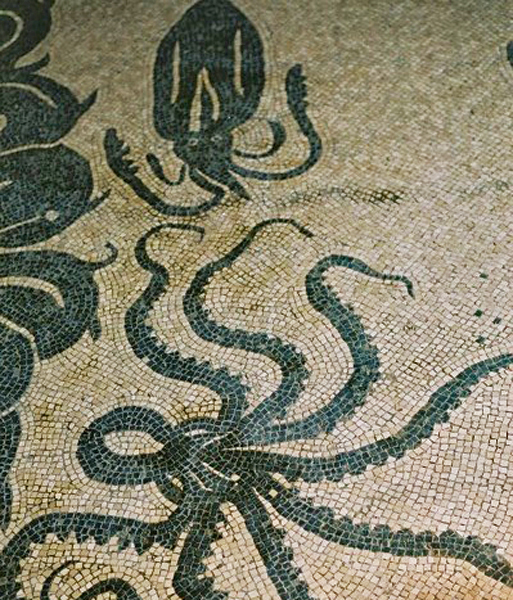
Detail of a mosaic floor in the women’s baths of Herculaneum
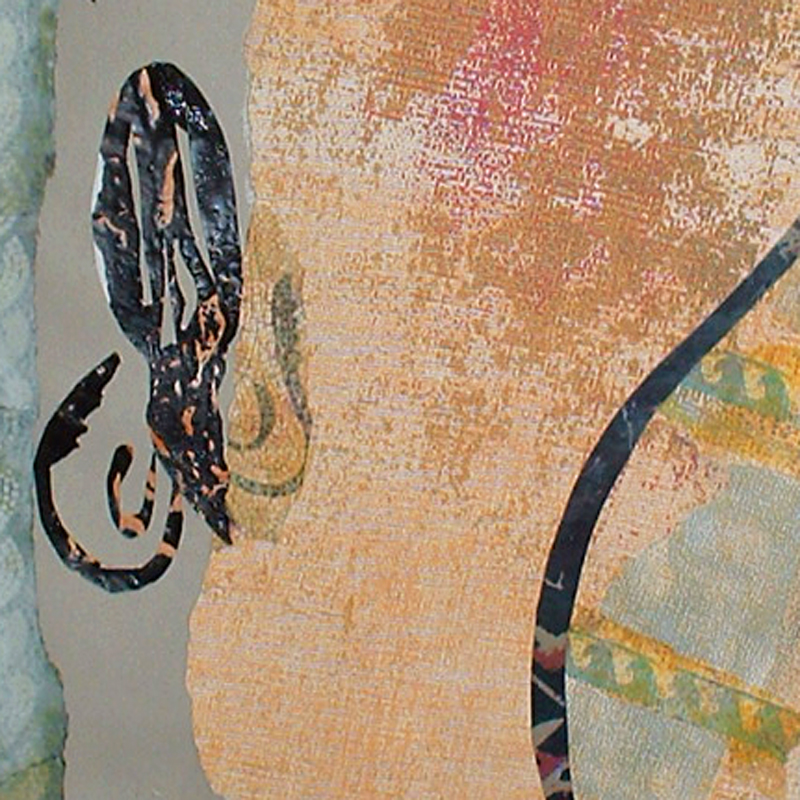
Wave #3, detail
However I was unable to incorporate the human figure into this work, and it was not until 2015 that I found myself in a position to do so.
The Paintings
Neptune’s Ocean
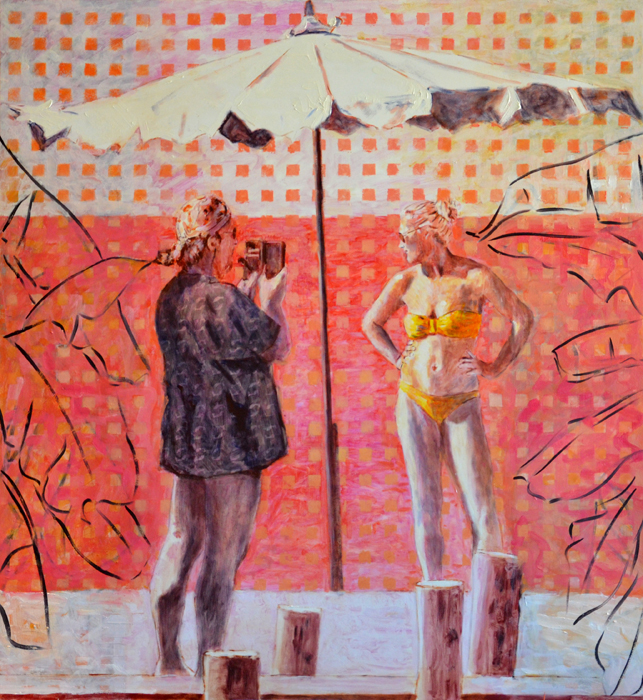
Neptune’s Ocean in 2015
In June 2015, I began working on some ideas based on beach scenes on the Andaman coast of Thailand and I perceived a connection between the images I was making and that of the Neptune and Salacia mosaic.
For example, there was a striking similarity between the large shell of the mosaic and the beach umbrella.
However I hoped to incorporate other ideas into these paintings, namely voyeurism, mine as well as Neptune’s, together with the use of new technology. Moreover there was initially an extra dimension to Neptune’s Ocean, which takes its title from Macbeth who has this to say to his wife:
Will all great Neptune’s ocean wash this blood
Clean from my hand? No, this my hand will rather
The multitudinous seas incarnadine,
Making the green one red.
It’s a wonderful piece of language, and I used it in my novel The Three-Towered Castle to convey the price paid for the act of murder.
When I began painting this picture, a terrible event happened in Sousse, Tunisia, on a beach much like the one in Thailand. I must confess to thinking during these past few years, when travelling to such destinations, that an attack like this on British tourists was inevitable. Consequently this painting was meant to have an edge to it. Not only is the older man capturing his goddess with a smartphone, but both are under threat from forms encroaching on either side, and the sea of course is not blue, nor green.
However in time I grew dissatisfied with the picture, and in 2017 I repainted it, removing the spiky forms and the patterned ‘sky’ to arrive at a simpler and, I think, a more cohesive painting.
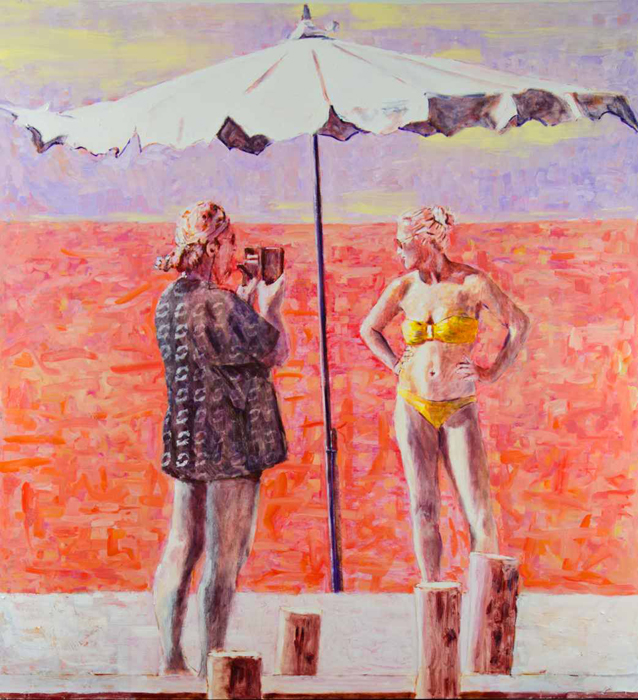
Neptune’s Ocean, 2017, 132cm x 122 cm, Oil on MDF
Neptune Rising
This painting took less time to complete, approximately four months. It was simplified during that period. The structure changed and various motifs, including references to Roman temples, were removed. The colour also became more intense as I attempted to capture the heat and intensity of light and colour which I experienced under the Thai sun.
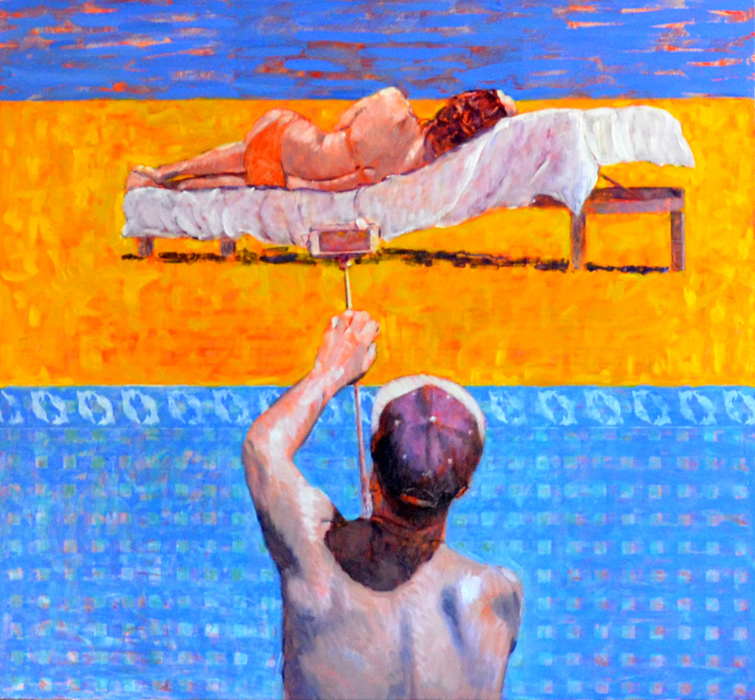
Neptune Rising, 2015, 122 cm x 132 cm, Oil on MDF
The myth recounts how Neptune sent a dolphin to search for Salacia. Consequently I incorporated a pattern of dolphins at the edge of the swimming pool. This motif also appears on the man’s T-shirt in Neptune’s Ocean.

A pattern of dolphins – Neptune Rising
My Neptune rises from the swimming pool and takes a photograph of Salacia as she sunbathes, while he pretends to take a selfie. Meanwhile an observer looks on, armed with a Nikon, a telephoto lens and a cold beer.